What Stage Is Your Hair Loss? The Norwood + Ludwig Scales, Explained
A board-certified dermatologist’s guide to hair loss stages — for every shade, every texture, and every stage of the journey.
If you’ve been zooming in on your hairline in photos, or your part looks a little wider than it used to — you’re not imagining it, and you’re definitely not alone. Hair loss (the medical term is alopecia) affects millions of women and men, and it almost never shows up overnight. It moves in stages.
Dermatologists use two main maps to track those stages: the Norwood Scale for male pattern hair loss and the Ludwig Scale for female pattern hair loss. Knowing your stage turns a vague worry into a plan — because the earlier we catch hair loss, the more options you have.
Here’s what each stage really means, where these scales fall short (especially for textured hair and skin of color), and what we can actually do about it.
Beverly Hills · Inglewood · Virtual across California
First — what are the Norwood and Ludwig Scales?
Think of them as the staging systems of hair loss. The Norwood Scale (sometimes called the Hamilton-Norwood Scale) maps male pattern baldness across seven stages, from a full hairline to extensive loss. The Ludwig Scale maps female pattern hair loss across three stages of thinning, usually starting at the part line.
Both describe androgenetic alopecia — the inherited, hormone-driven type of hair loss (yes, the one you can thank your family tree for). When I tell a patient they’re at Norwood 3 or Ludwig II, we’re speaking the same language: it tells us how far things have progressed and which treatments still have real room to work.
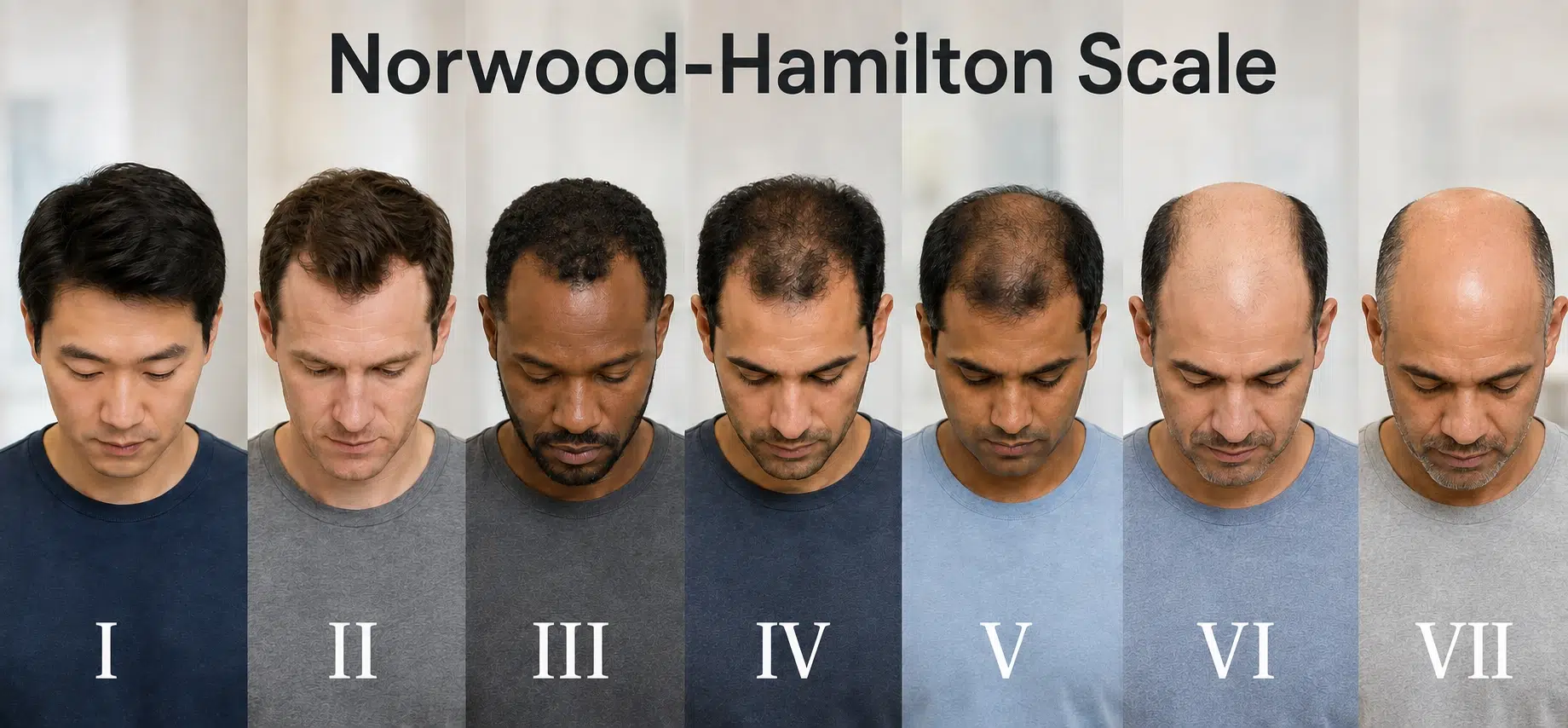
The Norwood Scale: the 7 stages of male pattern hair loss
| Stage | What’s happening |
|---|---|
| Stage 1 | A full hairline, no real recession. Nothing to treat — but if hair loss runs in your family, this is the perfect time to build good scalp habits. |
| Stage 2 | The hairline pulls back slightly at the temples. Subtle — most people only notice it comparing old photos. This is often the first whisper of androgenetic alopecia. |
| Stage 3 | The temples recede into a clear M shape. This is the first stage dermatologists consider true balding, and honestly? It’s my favorite stage to meet a patient, because treatment still has so much to work with. |
| Stage 3 Vertex | The hairline holds relatively steady, but a bald spot opens up at the crown (the vertex — the top-back of your head). Easy to miss, because you can’t see your own crown. |
| Stage 4 | Deeper recession up front plus a larger crown spot, with a band of hair still separating the two. The follicles in the affected zones are miniaturizing — shrinking and producing thinner, shorter hairs each cycle. |
| Stage 5 | That band between the front and the crown narrows. The two thinning zones are close to meeting. |
| Stage 6 | The band is gone — the front and crown have merged into one larger area of loss. Hair remains mainly on the sides and back. |
| Stage 7 | The most advanced stage: a horseshoe of hair along the sides and back, with the top largely bare. Options narrow here, which is exactly why I never want you to wait this long. |
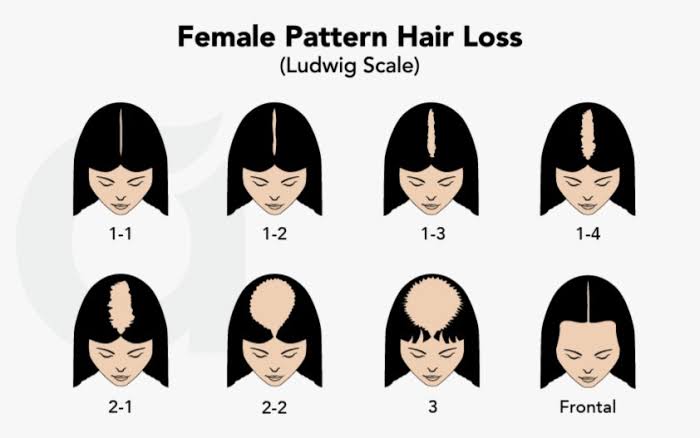
The Ludwig Scale: how women’s hair loss actually shows up
Women rarely lose hair the way men do. Instead of a receding hairline, female pattern hair loss usually means the part gets wider and the overall density drops — while the front hairline mostly stays put. The Ludwig Scale captures that in three stages.
| Stage | What’s happening |
|---|---|
| Ludwig I | Mild thinning along the part line. Your ponytail feels a little thinner; more scalp peeks through in bright light or flash photos. Very treatable. |
| Ludwig II | Moderate, noticeable thinning across the crown. The widened part is visible in most lighting, and styles that used to hide it stop cooperating. |
| Ludwig III | Extensive thinning over the top of the scalp — the scalp is clearly visible. The hairline often still holds, which is why this stage can sneak up from above. |
You may also hear about the Savin Scale — it’s essentially the Ludwig Scale with density measurements added. Same idea, finer detail.
What the Norwood and Ludwig Scales miss — especially for Black women
Here’s what most hair loss articles won’t tell you: these scales were built decades ago, largely by studying patients who didn’t look like many of mine. They only map one kind of hair loss — the inherited, hormonal kind. Two of the most common conditions I treat in my Beverly Hills and Inglewood offices don’t follow either map:
Traction alopecia — hair loss from years of tension on the follicle: tight braids, sleek ponytails, locs, weaves, and extensions. It shows up first at the edges and temples, an area the Ludwig Scale barely acknowledges. Caught early, it’s reversible. Caught late, the follicles can scar shut.
CCCA (central centrifugal cicatricial alopecia) — a scarring type of hair loss that starts at the crown and spreads outward, most common in Black women. Because it scars the follicle, the window to save hair is real: once a follicle scars, it doesn’t grow back.
So if your pattern doesn’t match the diagrams above, that is not a reason to relax — it’s a reason to get examined. A widened part could be Ludwig II. It could also be early CCCA. They look similar in the mirror and need completely different treatment. This is exactly why textured hair and skin of color deserve a dermatologist trained to tell the difference.
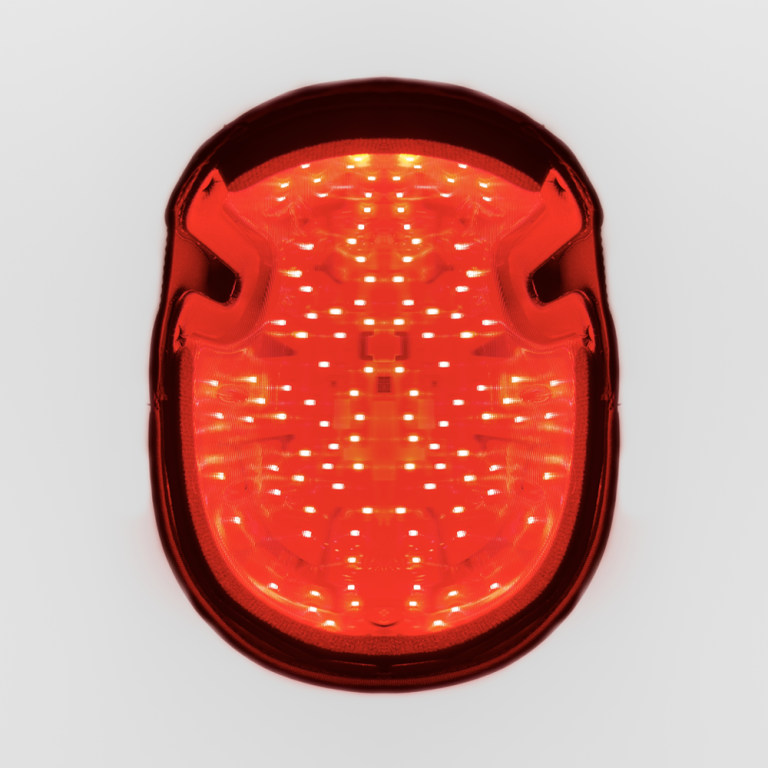
Red light therapy: the at-home tool I actually recommend
One of my favorite supportive treatments at almost any early-to-mid stage is red light therapy (also called photobiomodulation — light energy that stimulates the follicle). It’s painless, takes minutes a day at home, and pairs beautifully with prescription treatment.
The device I trust for my own patients is the REVIAN RED cap — an FDA-cleared wearable cap that uses dual-wavelength LED light to support the scalp and encourage growth. Ten minutes a day, controlled from your phone, no downtime.
We offer exclusive REVIAN pricing for Dr. Zoë Indigo patients only, directly through our office — so before you buy one online at full retail, talk to us first.
How we treat hair loss at SKIN/tervention
Whatever your stage, the visit starts the same way: we figure out what’s actually causing the loss. That means a close scalp exam (often with dermoscopy — a magnified look at the follicles), sometimes lab work, and occasionally a small scalp biopsy when we need certainty. Guessing is not a treatment plan.
From there, your plan may include:
- Prescription therapy — topical and oral options matched to your diagnosis, your hair texture, and your styling routine
- In-office treatments — including PRP (platelet-rich plasma: your own growth factors, injected into the scalp to wake up sluggish follicles) and steroid injections for inflammatory types of loss
- Red light therapy — the REVIAN RED cap as your at-home support between visits
- Scalp + styling strategy — real-world guidance that respects protective styles instead of just telling you to give them up
Every plan is calibrated for your hair — coily, curly, wavy, straight, relaxed, loc’d, or covered. That’s the whole point of a practice built for every shade and every story.
Hair Loss FAQ
Does the Norwood Scale apply to women?
Not really — it was designed for male pattern hair loss. Women’s hair loss is usually staged with the Ludwig Scale (or the Savin Scale). And some of the most common causes of hair loss in women, like traction alopecia and CCCA, aren’t captured by either scale — which is why an in-person diagnosis matters.
What stage should I see a dermatologist?
Earlier than you think. If you can see a change — a wider part, thinner edges, a deepening hairline, more scalp in photos — that’s the right time. Hair loss treatment protects the hair you have first and regrows second, so every month matters more at the beginning.
Is hair loss in Black women different?
The causes often are. Alongside genetic pattern loss, Black women are disproportionately affected by traction alopecia (tension-related loss at the edges) and CCCA (a scarring hair loss that starts at the crown). Both are treatable — and both reward early diagnosis, because scarred follicles can’t be revived.
Does red light therapy actually work for hair loss?
Red light therapy is FDA-cleared for androgenetic (pattern) hair loss and has supportive evidence for stimulating follicles. I recommend it as part of a plan — usually alongside prescription treatment — not as a lone miracle. Results vary from person to person, and consistency is everything.
Do you treat all hair types?
Yes — that’s the heart of this practice. Coily, curly, wavy, straight, relaxed, braided, loc’d, wig- or extension-wearing. Your treatment plan should work with your real life and your real styling routine, not against it.
What happens at a hair loss consultation?
A full history (health, medications, styling, family patterns), a magnified scalp exam, and a clear diagnosis-driven plan. If labs or a biopsy would change the plan, we’ll talk it through together. You leave knowing what’s happening and what we’re doing about it — in plain language.
About Dr. Zoë Indigo, MD
Dr. Zoë Indigo, MD is a board-certified Black dermatologist and founder of SKIN/tervention by Dr. Zoë Indigo, MD in Beverly Hills and Inglewood, California. A UCLA residency graduate and NIH researcher with a Harvard Medical School externship, Dr. Zoë specializes in medical and cosmetic dermatology for skin of color, including hair loss and alopecia in textured hair. She has been featured in Essence, Allure, HuffPost, and on Lifetime’s Dr. Pimple Popper.
Ready to find out your stage — and your plan?
You don’t have to diagnose yourself from diagrams on the internet. Bring me your edges, your crown, your part line, your questions — and let’s map exactly where you are and where we’re going.
Book your consultation today. In-person in Beverly Hills or Inglewood, or virtual anywhere in California.
Text us: (424) 722-9246 · hello@drzoe.skin